What is a social anxiety disorder?
Being afraid of other people and especially their opinion of you is known as a social anxiety. If it is so severe that it disrupts the regular functioning of life, then it could be called a social anxiety disorder. If you suffer from a social anxiety and you want to know what is a social anxiety disorder and whether you might suffer from that, check your symptoms when you are faced with a situation in which you have no choice and must be in a social setting. People with a social anxiety disorder (SAD) will often feel some of the following symptoms:
- Increased heart beat (which you can feel pounding)

- Sweating (often in the palms of your hands)
- Stomach ache or nauseas
- Blushing (often the most annoying symptom as it is seen by others)
- Hyperventilation (fast breathing)
- Feeling lightheaded as if you are going to faint
- Trembling (which you fear could be seen by the other people
What most people with SAD do
Well, they do the obvious and in most cases they seek to avoid the social setting in which they know they will have any of these symptoms. So any setting in which it is perceived that you will be judged, humiliated, being at the center of attention, will want to make you run the other way. This is very logical, who wants pain? Social anxiety can be so disturbing to life that it makes a lot of sense that people opt for avoidance.
From my experience, these settings are often; school settings, meeting unfamiliar people, parties, meetings with people in a higher rank, dating, writing/eating in front of others, complaining in a store or returning something that was purchased.
The trouble with that
I often ask people whether their SAD has gotten worse since they started suffering from it. In almost all the cases the answer is yes. Basically the avoidance help you in the short term. Long term however, there is a big problem developing as a result of the avoidance. It is as if you are allowing the SAD to rule you. And as you listen to that voice, the voice becomes stronger, becomes more bossy and wants to take over your life which is often how people with SAD feel. So whilst it is very understandable, the avoidance are making your SAD worse.
Safety behaviours
Safety behaviours are used by people with SAD when they are forced to comply and participate in meetings that trigger them so in order to make it more tolerable, they use safety behaviours. This is slightly better than complete avoidance. Here are some examples that I’ve seen;
- Going to the party but making sure to go along with someone else
- Making as if you are on the phone with someone
- Speaking to a stranger but making up some excuse why you can’t talk for long
- Excessive apologizing for something that is perceived to be on the mind of the other
How can SAD be helped effectively
Like other forms of anxieties, medication is an option. Usually your doctor will prescribe SSRI’s for a social anxiety such as Paxil, Zoloft or other ones in that group. Most of the time, SAD sufferers will see a great improvement in the intensity of their fears and will be less troubled by them. The research shows that the greatest benefit is from combining therapy such as Cognitive-Behavioral-Therapy (CBT) together with the medication.
Coping tools? 
So I will offer you some coping tools that will actually be used in therapy if you wish to go down that road. For a start make a list of all the settings that you avoid due to your social anxiety. Then put them in a hierarchy, going from the worst and most anxiety provoking to the least. You will notice that the items that you wrote at the top of the list (the most difficult), are the ones that you tend to avoid altogether. The items lower on the list are the settings that you don’t necessarily avoid but you do them with safety behaviours.
First step
At the bottom of your list you now have the easiest trigger for you but it is still a challenge. Now decide that you will confront this particular setting and drop the safety behavior that is associated with it. You need to remember that it will become easier after you’ve done so several times. Anxiety tends to work with a peak. At some point you will feel the anxiety rise and I want you to allow it to be there. Just breathe your way through it and keep asking yourself whether it is still going up or is it already on its way down. Allow yourself to be an observer of your anxiety and notice that you are surviving it. Your psyche will adapt and stop seeing this particular setting as a danger and stop giving you false alarms.
Second step
Allow yourself to stay at first step until you feel that this particular social setting does not give you any intense emotions anymore. Once you feel that this has been ‘neutralized’, you can go to step nr 2 and take the next easiest item on your list and do that again.
Some people find it too difficult to confront their social anxiety triggers on their own. If you feel that way, and it is just too difficult, a therapist specializing in CBT could be very helpful. You would be taught various skills on how to manage these confrontations. These therapeutic interventions are very useful in helping you to cope with the anxiety as you overcome them one by one.
Online therapy
The luxury of an online therapist is huge. You can stay at home and have contact with a therapist that will assist you in managing your social anxiety for which CBT is the most researched therapy model for it. This link will also get you a 20% reduction online-therapy
You can also read up more about it on this post
Bibliotherapy
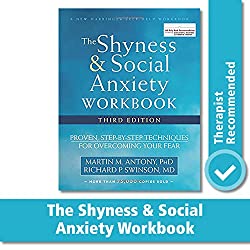
If you prefer to read a CBT book for the management of your social anxiety, I highly recommend 2 books that are very clear and guide you in a very step-by-step style in the management of social anxiety. The first one is ‘The Shyness and Social Anxiety Workbook. Clicking on the image will take you to Amazon to get the book
Title: The Shyness and Social Anxiety Workbook
Author: Anthony Martin
Price: $21.11
Cheapest place to get it: Amazon
My review: 9.8/10

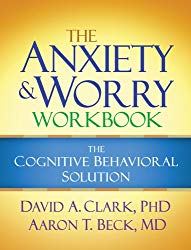
The second book that I recommend is ‘The Anxiety and Worry Workbook’ which is a best-seller and has been extremely successful in helping many of my clients with SAD
Title: The Anxiety and Worry Workbook
Author: David Clark
Price: $13.38
Best place to get it: Amazon
My review: 9/10

Audiotherapy
Some people have asked to provide links for audios they can listen to alleviate the pain of SAD and help them cope. I am providing here a link to an incredible audio pack which offers you 10 steps to overcome SAD and has been very helpful to many of my clients as well. Here is the link.
See here the video by the originator of this program in which he explains how this program works. Note that you have a money back guarantee for 90 days (!) so you can simply try it out. I’m hopeful that you will find this gives you relief from social anxiety.
I hope to have provided here some useful information on Social Anxiety Disorder with various ideas, coping tools and options for you to get started in getting significant relief.
Please do ask questions below or leave comments and I will do my best to answer as fast as possible. You can also email me to [email protected]
To your health,
Aaron